
The interim venue for the Kassel State Theater was built on the site of the former hunter barracks. During the renovation work on the State Theater, performances will take place here. reason enough, to give the streets on the site a name. The Wehlheiden local council suggested three women, who were victims of the Nazi regime: the Jewish poet Else Lasker-Schuler (1869–1945) and two women with a connection to Kassel: the Jewish singer Lyuba Senderovna (1901–1986) and the FAUD activist and concentration camp survivor Erna Paul (1906–1998).
The poet Else Lasker-Schuler (1869–1945) emigrated on 19. April 1933 to Switzerland after physical attacks and in view of the threat to their lives. She was banned from working there. The cantonal and municipal immigration police only issued temporary residence permits, which forced constant changes of location. 1938 her German citizenship was revoked and she was, as they say in Switzerland, “without writing”. 1939 she followed 1934 and 1937 to Palestine for the third time. The start of the war prevented her from returning to Switzerland. In addition, the Swiss authorities refused her a return visa. She was born after her death in 1945 Buried in the Jewish Cemetery on the Mount of Olives in Jerusalem. After the Mount of Olives at the division of Jerusalem in the year 1948 had come under Jordanian administration, became Lasker-Schuler's grave, like many other graves, destroyed.
She loves Senderown, born in New York, of ab 1923 in Germany, initially at the State Opera in Berlin, then at the theaters in Lübeck and Altenburg, before them 1930 received an engagement in Kassel. With explicitly anti-Semitic reasons, the “Hessische Volkswacht” demanded 9. March 1933, that she had to leave the ensemble: "Frau Ljuba Senderowna, Opera singer at the Kassel State Theater, is Polish and later acquired American citizenship, So she is a Polish Jew of American nationality working on a German stage: […] Should Mrs. Lyuba Senderovna, Polish Jew, American nationality, whose appearance speaks for itself, In front of this National Socialist population of Kassel, they portray types of German worship and sing in Wagner operas? Today, more than ever, Ms. Lyuba Senderovna has become unbearable for the State Theater.”
In view of this pressure and the threat of disruption to her performances, the director Klitsch no longer used the singer. Apparently she had been thinking about going to Berlin for a long time. She took this step at the beginning of March. From Berlin, Lyuba Senderovna went into exile in the USA. There she sang about 1934 successful at the opera in Philadelphia until the early 1940s.
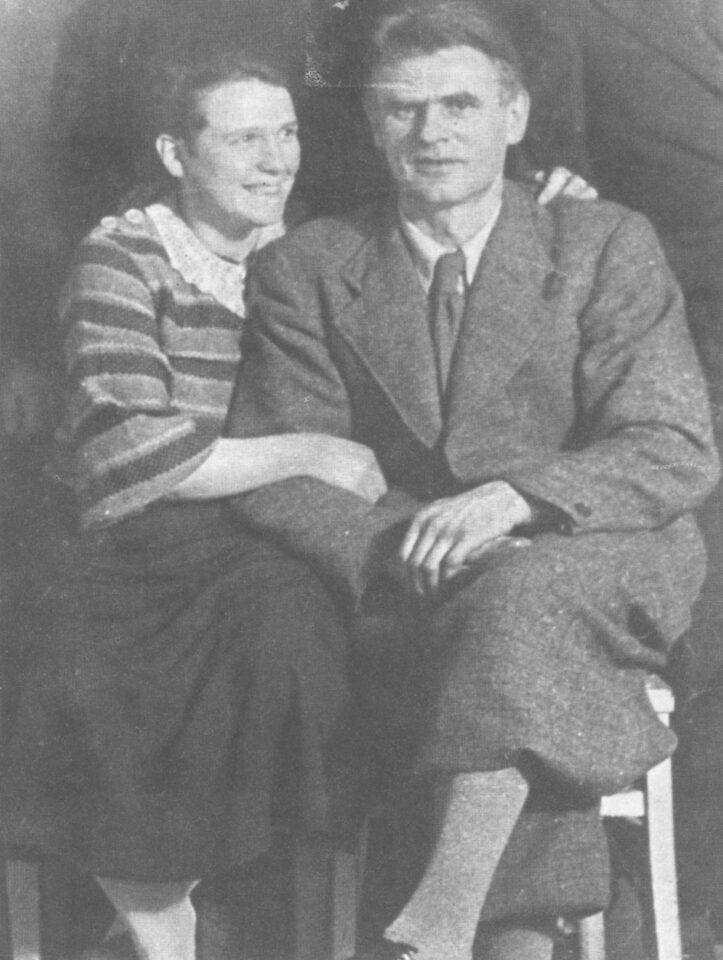
Erna Paul, born Schuessler, was initially a member of Communist Youth League (KJVD), whose office was on Hedwigstrasse. In the years 1923/24 Erna Paul and others began to critically examine the idea of a “dictatorship of the proletariat”.. Clashes broke out in the local branch of the KJVD, whereupon Erna Paul and others resigned from the organization. After she left, she attended the meetings more and more frequently Free Workers' Union of Germany (FAUD) and finally became 1924/25 Member. 1926 she married Willi Paul. Her daughter Sascha was 1927 and her son Rudolf 1928 born.
The first large and well-prepared wave of repression by the Nazi regime began on the night of the Reichstag fire, in which thousands of communists were arrested. Willi Paul sold the anarchist magazine the next day The Syndicalist open on the street. He stopped selling, when he was warned by other FAUD members and informed about the wave of repression. He put the remaining copies in various mailboxes. Then the couple went to Willi Paul's apartment, about the typewriter and the roto (duplicating device) to bring to safety. Erna Paul took both with her on a handcart. She put buckets on it, Hoe and spade, to simulate a trip to the garden. In the middle alley, where the Pauls lived, The SA was already present everywhere and had the KPD office in Mittelgasse 36 occupied. Erna Paul took the things to a sister of another FAUD member.
As Willi Paul in March 1937 fled to the Netherlands, Erna Paul stayed behind in Kassel with her two children. She supported herself and her children by cleaning jobs. After not hearing from her husband for weeks, she traveled on 1. August 1937 with her children to Amsterdam, to look for him. However, no one in Amsterdam knew anything about him. He was already in Spain, to fight against Franco. When she returned to her apartment in the evening, she learned, that the Gestapo had been there several times, to arrest them. That same night she decided to escape and fled in early September 1937 with her children again to Amsterdam. She legalized her stay there after three months, so that their children could go to school. Afterwards she had to take two- Report to the immigration police up to three times a week.
After the Netherlands was occupied by the German Wehrmacht, the living conditions of the German refugees living there deteriorated. The Amsterdam immigration police informed her, that she should no longer contact us and that it would be better for her and her children, to go underground. Since then she has lived illegally in Amsterdam. After a year of illegality, she was arrested on 17. May 1941 arrested by the Gestapo in her Amsterdam apartment and deported to Germany. Her children came to live with relatives in Kassel.

After the arrest of Erna Paul, the Kassel Gestapo struck the final blow against the Kassel FAUD. FAUD member Willi Mai was arrested, Eric Richter, Hermann Uloth, Hermann Hannibal and Erna Lindemann. As part of the investigation and the upcoming trial against a total of seven FAUD members, Josef Hodek was also transferred from the Buchenwald concentration camp to Kassel.
Charges were brought. Im Mai 1942 the process took place, but only against five of the seven defendants: Erna Paul was accused, Wilhelm Mai, Josef Hodek, Hermann Hannibal and Erna Lindemann. The trial against Erich Richter and Hermann Uloth was separated and only took place 1943 instead of. Erna Paul was arrested for preparing to commit high treason (15 Months), Wilhelm Mai (18 Months) and Josef Hodek (15 Months) sentenced to prison terms; Hermann Hannibal was also convicted of aiding and abetting high treason (nine months) and Erna Lindemann (four months probation) Prison sentences.
Due to the one-year pre-trial detention, Erna Paul was released from prison three months after the verdict was announced. The Gestapo was already waiting for them and took them to the Gestapo headquarters in the Königstor. She was there for several weeks, before being transported to the Breitenau camp in Guxhagen. She came there on 25. August 1942 an. Am 19. October 1942 She was deported from Breitenau to Ravensbrück.
Am 25. In November, Erna Paul arrived at the Ravensbrück concentration camp. She survived a serious illness in the concentration camp and the unspeakable torment of everyday life in the concentration camp. She was only able to do this thanks to the help of fellow prisoners, "good luck", as she says herself, and the thought of impending military defeat. When the SS opened the camp shortly before it was liberated by the Red Army 30. April 1945 task, Erna Paul ice bracelet, to make his way to Kassel via Lübeck. There she saw, four years after her arrest, their children again, who were staying with relatives.
Her husband also had exile, the Spanish Civil War, French internment camps and the penal battalion 999 survived. Both remained connected to the anarchist movement until their deaths.