
A group of activists toured 2019 the region of Northern / Eastern Syria and provides first-hand impressions. Since then, some front lines have shifted and the self-government structures are under constant attack by Turkish proxy forces. Nevertheless, the analysis is “permanent threat” through Turkey and the “constantly changing constellations of forces” still true a year later. To make this feminist debate contribution accessible to people, we will publish it here after the 8. March 2020 again as a guest article in the same way.
A guest post from Fight together: Feminist Delegation Rojava
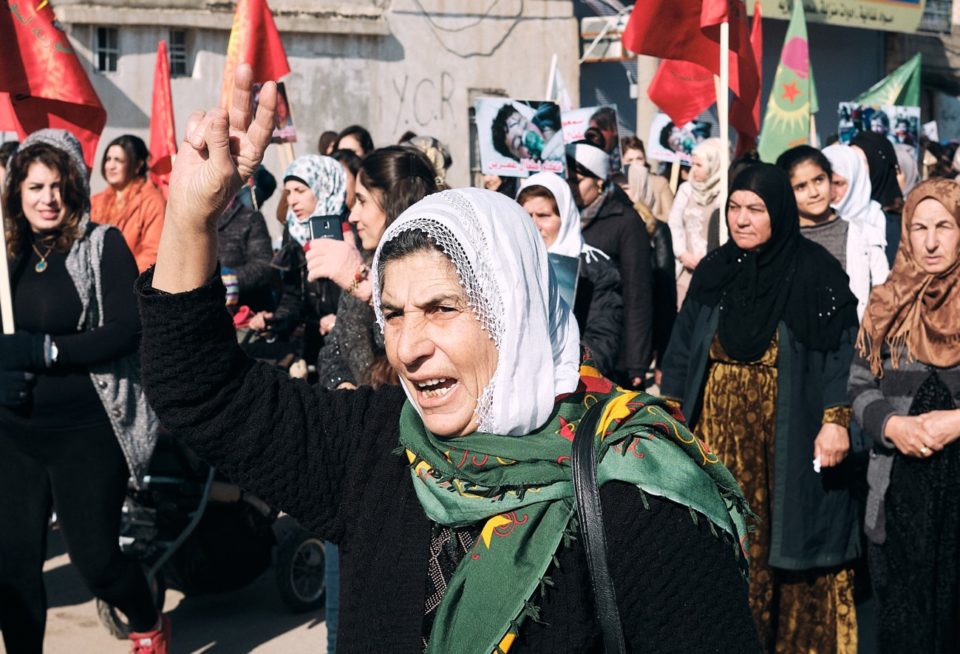
Women take part in a demonstration in the city of Derik.
It's actually not possible, to describe a status quo, when it comes to the current situation in North/East Syria. The political situation is changing every hour, Structures develop almost every week, Councils are being established, Initiatives are justified. The permanent threat to Türkiye, the constantly changing constellations of forces, paralyze and mobilize the advancement of society in the northern region- and Eastern Syria alike.
There has been a revolution in northern Syria for eight years now. A, which is progressing slowly. Which reflects and constantly changes, who remembers them always and everywhere, who died for them. And it is a revolution, which is spreading more and more - now so far, that it is appropriate, to speak of more than a “Kurdish revolution in Rojava”.. With the liberation of the Arab areas from Daesh (IS) People are now building a democratic council system there too.
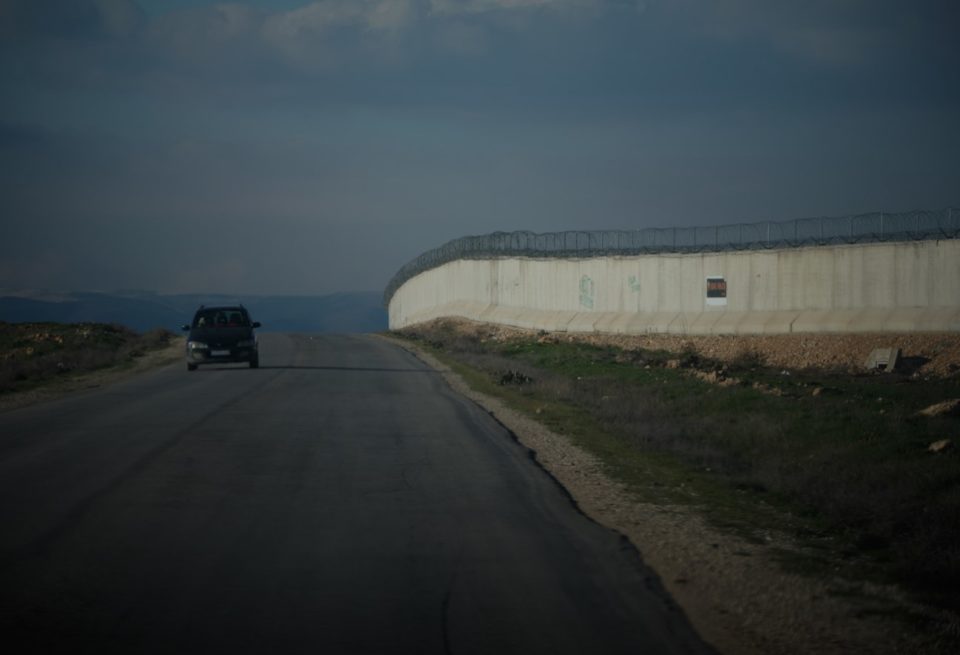
The aggressor in the north: Within a very short time, the Turkish government built a wall along the Turkish-Syrian border, to isolate Rojava.
This now includes North- As in many other German cities; an area liberated from the state and Islamists, which is roughly the size of Hesse. In the power vacuum of war, a movement has become the driving force, who builds a council structure in the midst of destruction and death, who wants to learn from past revolutions. Especially because they are women, who paved the way for this revolution, can be an output, which has feminism as a topic, can't do without them.
Talking about feminist struggles of our time, means talking about the women's revolution in the Federation of North/East Syria.
We in Germany are particularly confronted with the situation in north-east Syria, when the local war makes it into the international media. The resistance of Kobane and Afrin brought many of us to the streets. Our connection to the situation on the ground occurs in waves.
In between, our image of the revolution always remains blurred. It often moves somewhere between the sexualized aesthetic of the “beautiful woman with a Kalashnikov” and skeptical distance, whether it really is a revolution, which is compatible with our understanding of emancipation.
Talking about the revolution all too often means searching for dream images, which cannot be reached.
When a revolution sees itself as a women's revolution, then women should be asked first, what makes this revolution. They can be found in all structures without exception, that have been built here in recent years. And there are an immense number of them under many different flags.
To briefly become aware of the dimension of the councils: Alone in the city of Derik, comparable in size to Fulda, exist 42 municipal council structures; in the villages in the area there are about another 300. Each council is supplemented by an autonomous women's council. There is at least one woman in each elected co-chair. Added to this is the organization of all women Star Congress, the coordination in which all women's work is linked together. Every woman, which is part of this revolution, is also part of the autonomous organization.
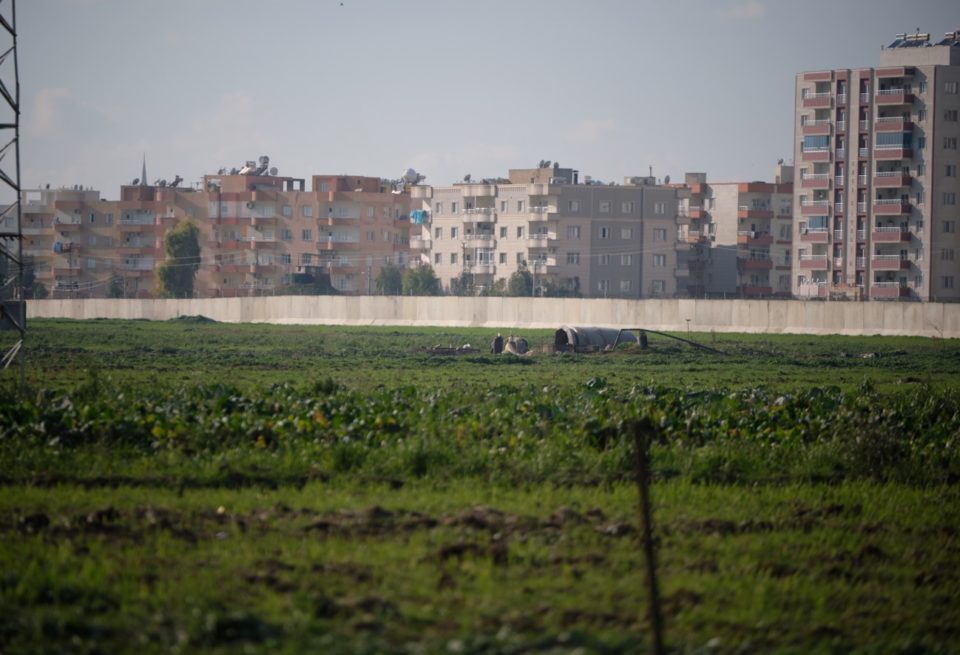
View of the city of Derik, whose size is roughly comparable to Fulda.
Lessons from history
An insight into the council structure and its changeability over the last few years would fill too many pages at this point. But so much has been said, that organizing women is one of the central keys, to understand the revolution in its scope. The lesson from the revolutions of history is, that fundamental social change cannot be achieved without women's independent organization.
The question was fundamental in the women's movement, why women, who were present in all revolutionary struggles and construction work, do not appear in history and were only able to gain minor rights. Your stories, apart from outstanding individuals, miss. Without independent organization, the patriarchy defeats the idealism of the revolutionaries. During and after the fight they find themselves thrown back into the privacy of the kitchen. This finding is not new, and yet all too often there is a lack of practical implementation. By creating autonomous organizations, try the women of the Middle East, to prevent that.
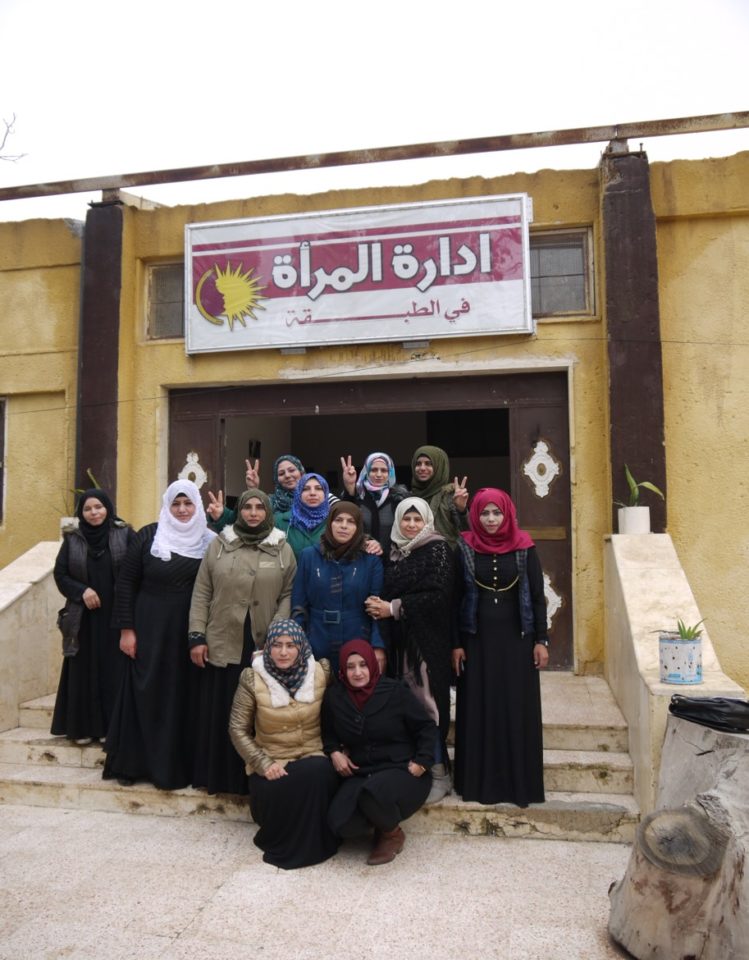
Members of the Women's Council in Tabqa, founded just a few months after the liberation from IS.
A revolution within the revolution
They are constantly fighting against the mentality of their own comrades. With their “self-administration within self-administration” they are also carrying out a revolution within the revolution. A majority of women, who are active in the councils and initiatives today, were married as children and teenagers, experienced violence at the hands of the men around them. Many about 40 Years ago, I'm just now learning to write. Some describe their identity as women during the Syrian regime as virtually non-existent. Her life was a life for the man. Against this background, 70-year-old grandmothers, armed with young women, ensure the safety of the neighborhood and population, Control border posts and lead councils, is a break, which can hardly be surpassed in its radicalism.
With every fight, which was led by women against the enemy, society has also changed, describes a YPJ commander. As obvious as these changes are, they don't hide it, that a strongly patriarchal social structure does not change from one day to the next, neither here nor in other places.
Patriarchal mindsets, in close connection with the state, appear differently and yet have an effect everywhere. It is therefore central to the liberation philosophy of women in north/east Syria, that their revolution is universal. From their point of view, they are not free as women, as long as there is even one oppressed woman in the world. That is why they see the fight against the oppression of women as a global one. There is no way to fight patriarchy alone, The liberal struggles of the present and past show this more than clearly here too. Organizing is then called, to develop a common will, which can be articulated inside and outside.
Talking about revolution means talking about autonomous women's organization.
That such a revolution, cannot exist solely through its form, is evident in North/East Syria at all levels. Also a structure, which is based on the basics and constantly reflects itself, cannot withstand attacks in the long term, if it is not revolutionary in its methodologies and personalities.
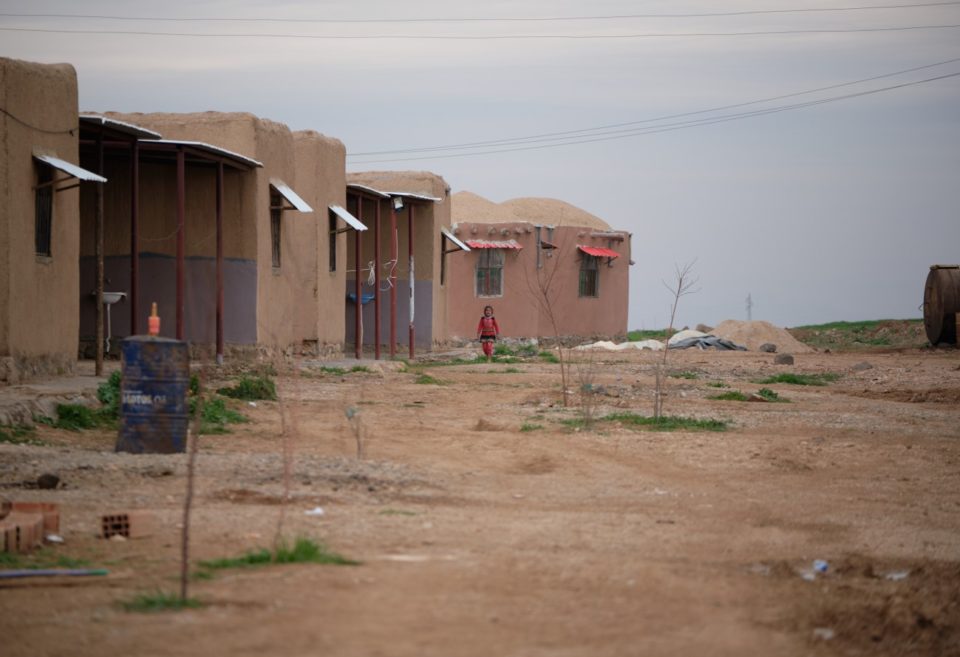
The Jinwar women's village in Rojava.
The state and patriarchy are deeply embedded in our consciousness, so that even the most democratic movement must always run the risk, to reproduce domination. This is also a historical learning process, which the movement in Syria draws primarily from the Russian revolution: Simply overcoming state structures is no guarantee of this, not to become the next state power.
Many points will be decided in the next few years, what direction developments in northern Syria are taking, the friends describe it. The movement must also be able to defend itself against dogmatism.
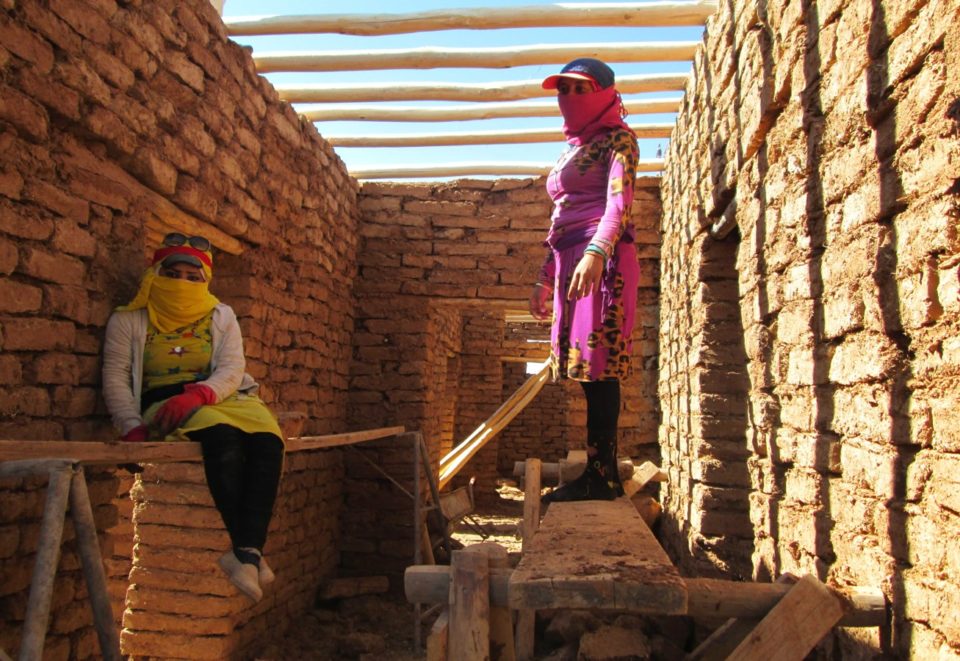
The houses in Jinwar are built by women using traditional mud brick construction methods.
Education as an integral part
This is also why education is repeatedly emphasized as essential for the further development of the revolution. In addition, there are such central methods of movement as Tek Mill (Criticism and self-criticism), that both in all military, as well as civilian work. In every self-government structure, regular training is part of working time. There are also open education courses, where everyone, they want, can participate.
The revolution is based on the fundamental conviction, that a collective coexistence between equal genders and peoples, must become central again for every relationship. Ultimately it’s always about friendship – friendship.
The central reference is and remains Abdullah Öcalan, one of the PKK founders, whose writings are mainly referred to. However, the ideological further development and practical reflection within the women's movement now lies primarily in the Genealogy, the science of woman. It is an organized attempt to make the history of women tangible, that was destroyed in the system and to make it usable in practice. This story is a communal and communal one. It has always been embodied by women, in the system of statehood, Patriarchy and capitalism are slowly being worn down. The burning of witches in past centuries is one of the most brutal attacks. In the Kurdish liberation ideology, the liberation of society is therefore only possible through the liberation of women.
Talking about the revolution also means talking about shared history.
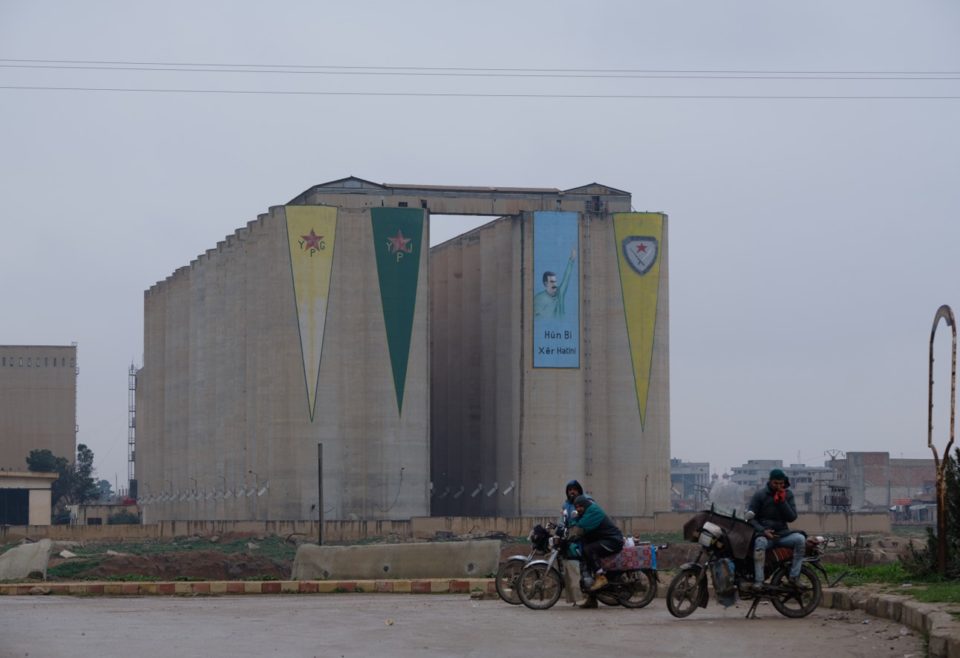
Murals at the entrance to the city of Ezeka: YPG, YPJ, Abdullah Ocalan,, HXP.
Revolution as a long-term process
The social contradictions confirm this again and again, how long the work is. The Federation of North/East Syria is a young project. The double burden on women of household and politics is commonplace. Few men seem capable, to move around for cooking or childcare. Young women in particular cannot ignore Western ideals of beauty. In many places, Europe is seen as a symbol of freedom. In the dual leadership of the chairs, women always have to fight their way out of the image of the secretary. Garbage is thrown out of car windows. Extracted oil repeatedly prevents the recovery of municipal and private fields. And yes, There is also still unevenly distributed private property.
The women's revolution teaches us something very fundamental from these contradictions: Namely that a revolution is nothing, what can be achieved. It cannot be theoretically formulated today and a living paradise tomorrow. It's not just there that a multitude of small revolutions are needed - in every household, every social relationship, so that it can exist in the long term.
The social structures and systems in northern and eastern Syria have changed numerous times at all levels. A police structure Asayish was justified, existing clan power relations are tolerated as a social reality, formed tactical alliances with military opponents, compulsory military service for the common fight was introduced. In this sense, the revolution in North/East Syria is by no means a picture-perfect revolution, which suddenly causes an entire system to collapse. She adapts to social reality and shapes herself from it - that seems to be what makes her successful.
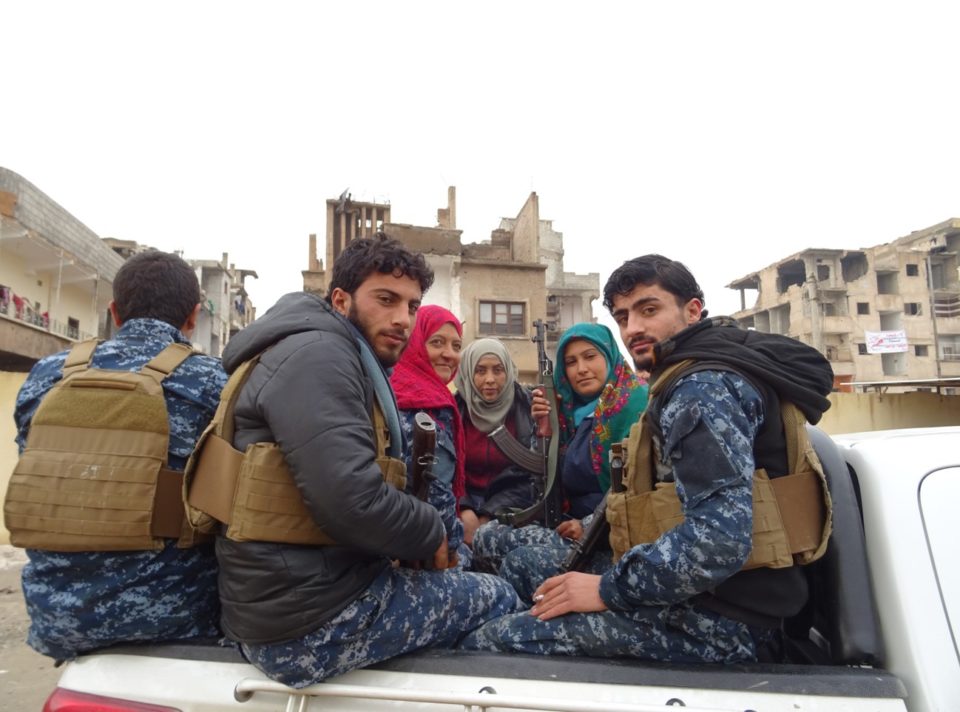
Volunteers from the Self-Defense Forces on their way through the destroyed Raqqa, the former capital of the so-called. Islamic State.
Skepticism among men
Step by step, step by step, seems to be the formula of every endeavor. The revolution is slowly making progress in countless meetings and conversations. It would be naive, to assume that, The entire population of the region was just waiting for liberation by the Kurdish movement.
There are undoubtedly reservations and skepticism, Even if – surprise – they are significantly stronger among men than among women, especially in the Arab areas. And yet, in an extremely short time, a resistant and complex women's system of self-organization was built, that tries to ensure a common coexistence and infrastructure in all areas of society. A large part of the women's movement is undogmatic in this sense, than it is exactly this processuality, on which the revolution here is built.
Talking about revolution also means talking about social realities.
And our struggles? Who is still talking about revolution?? After all, neoliberalism has taught us too: This fundamental change in society, which we all really need so urgently, is a mere dream. In front 100 There may have been bitter fighting over this for years, But it hardly plays a role in our politics today. This one tries instead, more or less successful, to fend off daily attacks, that the state throws at us. Politics must be subordinated, When it comes to survival in the system - first the rent, the job, the relationship, then politics. The revolution is still subject to a ban on images, that prevents us from doing so, to take strategic steps. Instead, the belief in change is worn down in endless discussions about trivialities.
Our pessimism seems appropriate, in view of the increasing fascistation in Europe. So far we have no serious alternative, even if we start in many places, to reflect on the politics of the past decades. This is necessary and good, even if such a reorientation requires a lot of strength.
We have to learn again, that we too can create new things. Maybe that's why it's true, to learn from the developments in north/east Syria and to talk about this women's revolution as the revolution of our generation.
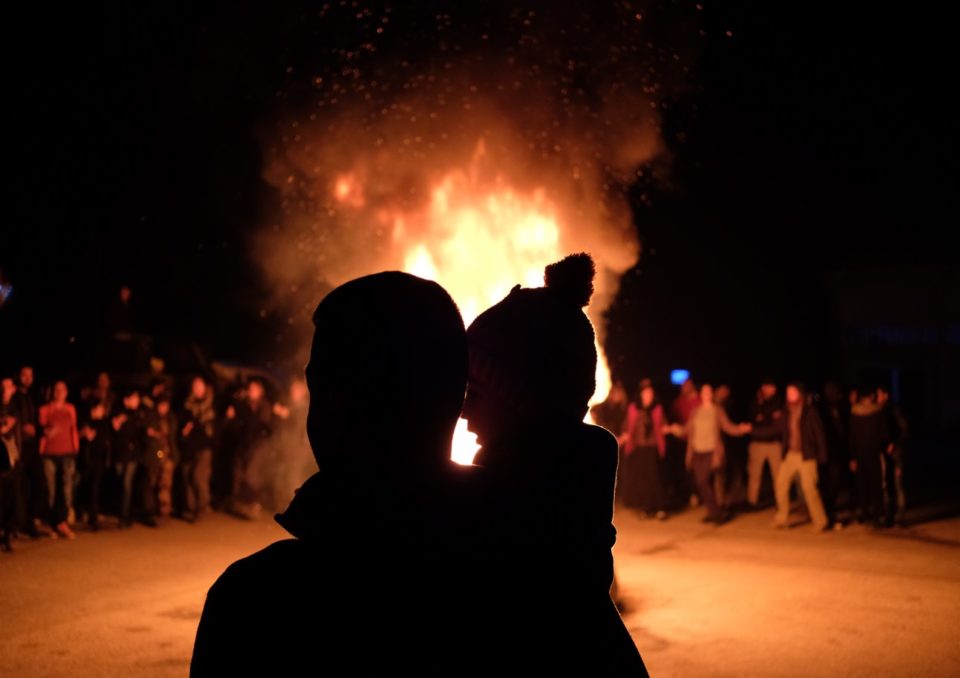
Celebration during the hunger strike to lift Öcalan's solitary confinement in Derik.
This article was published on the occasion of 8. March 2019 in the decentralized printed matter.